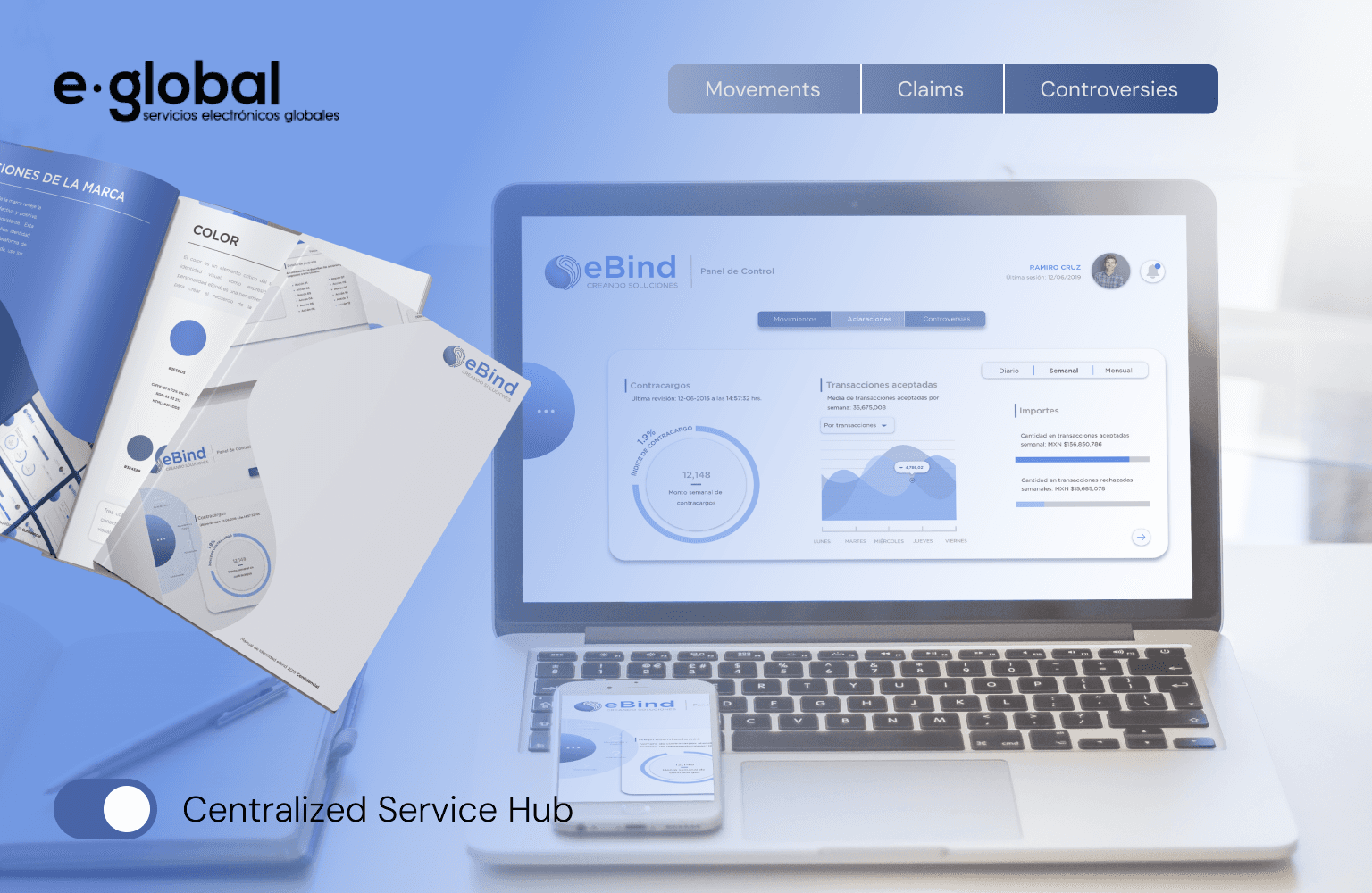
Designed the UX strategy and interface for Mastercard's Domestic Disputes Resolution (DDR) platform, a B2B tool that lets issuing and acquiring banks manage chargeback claims across three transaction products.
Delivered through Marabunta as a vendor to CSA Consultores, the work spanned information architecture, a six-role permission system, and final UI screens built inside Mastercard's own B2B design system.
Creative and Strategic Director, Senior UI/UX Designer, Senior Design Researcher
Junior UI/UX Designer & Junior Motion Media Developer (Daniela Marín)
Junior Design Researcher (Rossana Vizcaino)
Design Research
Design Strategy
UI/UX Design
Design-Engineering Handoff
Motion Media
Project Overview
Banks working with Mastercard needed a single platform to manage disputes and chargebacks arising from point-of-sale (POS), automated teller machine (ATM), and credit card bill payment (CCBP) transactions—but different institutional users needed very different levels of access to the same information, from a super-admin overseeing multiple banks down to a front-line operator handling individual claims.
Project Challenge
Reconciling a multi-role permission system into something usable was the first challenge, as well as working inside Mastercard's existing B2B Web UI Kit rather than a blank canvas while coordinating three transaction products—POS, ATM, and CCBP—each running its own claim lifecycle, into a single coherent dispute-resolution experience.

DDR gave Mastercard's banking partners a working system for managing disputes without needing a different tool per institution type or product line. It also left behind a set of new B2B UI components designed to extend beyond this one platform into Mastercard's wider design system.

Distinct Institutional Roles
Unified all roles—Super Institution, Institution, Operator, Manager, Audit, and Super Manager—into one shared platform architecture rather than six separate builds.

Transaction Products
Designed a single, consistent claim-tracking pattern applied across varying transaction products, each running a different underlying dispute process on the backend.

The project moved through a tightly sequenced UX process. It started with framing: defining the objective, running a SWOT analysis, and setting vision, mission, and scope, then grounding that framing in two personas representing the platform's most different users—a Super Institution financial director and an Institution-level commercial consultant.
From there the work moved into structure: mapping the full information architecture and a use-case/permission model across all six roles before a single navigation map was drawn. Navigation maps and wireframes came next, worked out role by role to confirm the shared structure actually held under six different permission sets.
Only once that structure was validated did the work move into surface design—applying Mastercard's B2B Web UI Kit to the finished wireframes—and finally into an interactive prototype for handoff.
10 weeks


Key Design Principle
This meant nothing stayed conceptual. Every diagram, component, and interaction had to be specified precisely enough that engineering could build directly from the deliverable without needing us to fill in the gaps later.

Key Design Principle
This meant designing the previewing and dashboard for the claims lifecycle once—as a single reusable framework—so each transaction process could plug into the same underlying logic.
Conclusion
DDR is the kind of project where success looks frictionless—users never have to think about the role they're in, or which of three products a claim came from, because the structure underneath absorbed that complexity before it ever reached the screen. It sharpened something about the kind of design work I find most worth doing: not the interface people notice, but the invisible architecture that makes noticing unnecessary.