Menu

View all work

View all work

Designing Connection: Launching Alumni-Student Conference

Designing Connection: Launching Alumni-Student Conference

Designing Connection: Launching Alumni-Student Conference

Project Description

Project Description

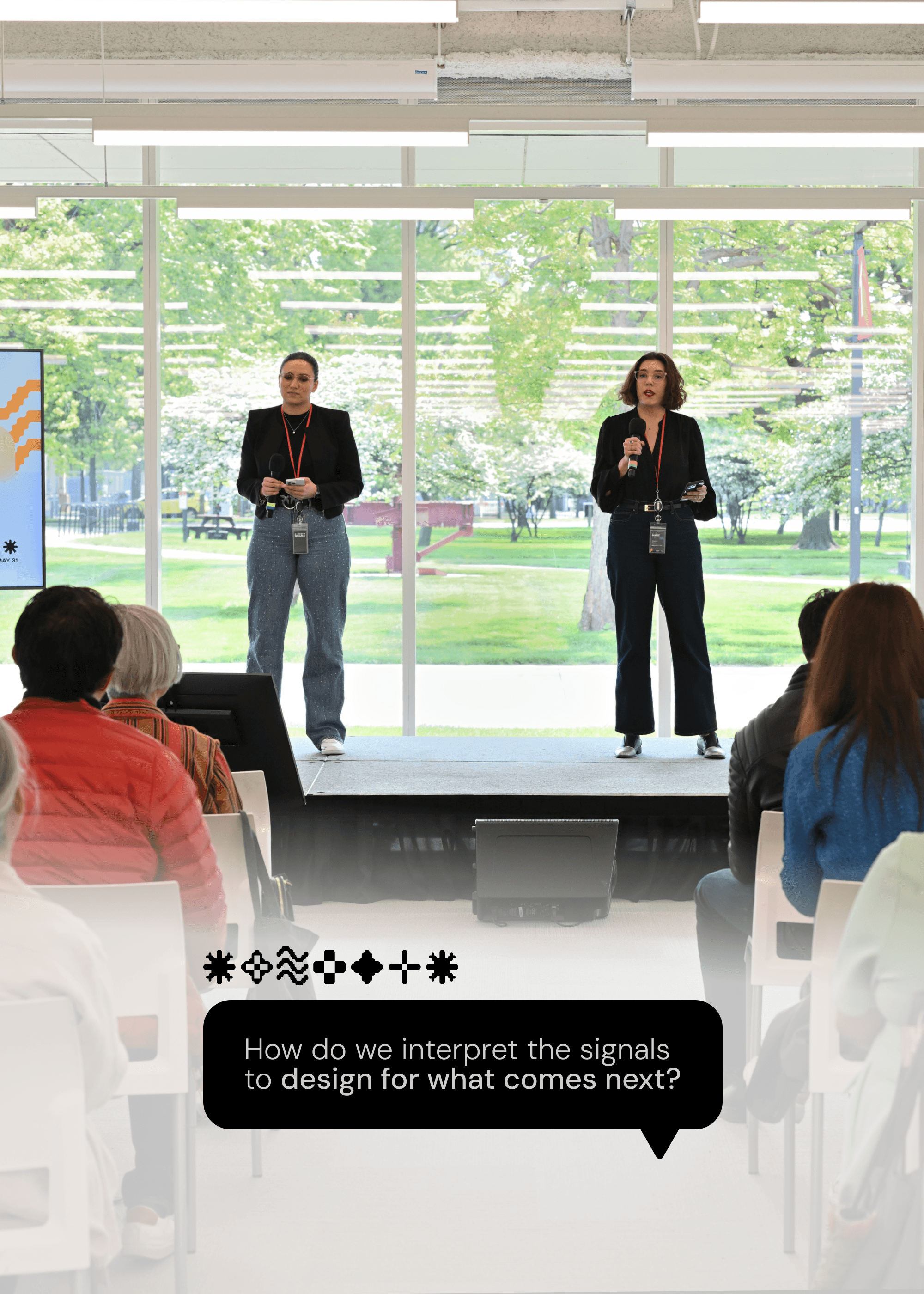
Built the conference from a blank slate: a first-of-its-kind, student-led conference designed to reconnect Institute of Design alumni with current students around a shared question—how do we interpret the signals shaping what comes next in design?

Owned the project end-to-end for most of its five-month build, from theme and speaker strategy through venue, catering, hybrid production, and the content strategy that carried the event's reach past the room itself.

Role

Role

Co-Chair & Creator

Team

Team

Co-Chair (Daniela Vélez)
Student Committees (5)

Toollkit

Toollkit

Experience Design
Facilitation Design
Project Management
Design Strategy

Year

Year

2025

2025

Project Overview

The Institute of Design had never run an event like this. Alumni were a core part of the school's value proposition, but had drifted from the current student experience, and there was no existing platform for alumni and students to engage. SIGNALS set out to close that gap: a one-day, hybrid conference built around knowledge exchange, cross-generational dialogue, and a shared forward-looking question, aimed at reconnecting alumni to the school while giving students direct access to the people further down their own path.

Project Challenge

Approaching the challenge from a first-year student position, resources, institutional knowledge, and precedent were scarce. We were not only working without a playbook; we also had to identify a single theme compelling enough to resonate with alumni years into their careers and students still finding their footing, re-engage a historically disconnected alumni network, and recruit students to speak and staff the event alongside already demanding academic workloads.

Project Impact

Project Impact

The project gave the ID a working template for reconnecting its alumni base and set a structural precedent—hybrid access and post-event documentation—that shaped how the Institute approached community events going forward.

Metrics of Success

Metrics of Success

160

160

Attendees (in-person and virtual)

Attracted the highest turnout ID had recorded for this kind of event, built from zero precedent and no prior alumni-engagement platform to draw on.

13

13

Recorded sessions

Published and shared content generated over 600 interactions, extending the conference’s reach well beyond the people in the room.
Approach

Approach

The five-month build moved in four phases.

The first two months were spent almost entirely with Daniela: settling on the shared theme, mapping what each of the four stakeholder groups actually needed from the event, and defining a core planning structure before bringing anyone else in.

Months two through three shifted into outreach — building the speaker and alumni-engagement strategy, securing the venue, and starting marketing — while beginning to pull the broader student committee into concrete pieces of the work.

Month four locked the program itself: confirmed speakers and panelists, catering, and the hybrid production plan, with the wider committee and alumni advisory group now carrying their share of staffing and outreach.

The final month was execution — running the day itself, then immediately turning to documentation and a recap strategy to extend the event's reach in the days that followed.

Timeline

Timeline

20 weeks

Insights

Insights

Four stakeholders, four different reasons to show up.

Four stakeholders, four different reasons to show up.

Early mapping made clear that students, alumni, faculty, and administration weren't one audience with shared interests—each group wanted something different from the same day: students wanted access and guidance, alumni wanted reconnection and relevance, faculty wanted community, administration wanted a durable engagement channel. Designing one event that answered all four, rather than averaging them into something generic, shaped later decisions.

Ownership had to be real to produce real investment.

Ownership had to be real to produce real investment.

The broader student committee's engagement tracked directly with how much genuine decision-making they were given, not just tasks to execute.

Shared leadership only built authentic community investment when it meant real collaborative ownership—a finding that changed how work was delegated in the second half of the project, and shaped the peer-to-peer tone the conference itself was built to model.

Commitment is contagious, but only once it starts somewhere.

Commitment is contagious, but only once it starts somewhere.

Cold outreach to a disengaged alumni network mostly went unanswered until a handful of well-known alumni committed first. That discovery reshaped the entire recruitment sequence: securing a few high-credibility "anchor" alumni became the actual strategy for building the rest of the list, not an afterthought once the harder outreach had already started.

Four stakeholders, four different reasons to show up.

Early mapping made clear that students, alumni, faculty, and administration weren't one audience with shared interests—each group wanted something different from the same day: students wanted access and guidance, alumni wanted reconnection and relevance, faculty wanted community, administration wanted a durable engagement channel. Designing one event that answered all four, rather than averaging them into something generic, shaped later decisions.

Commitment is contagious, but only once it starts somewhere.

Cold outreach to a disengaged alumni network mostly went unanswered until a handful of well-known alumni committed first. That discovery reshaped the entire recruitment sequence: securing a few high-credibility "anchor" alumni became the actual strategy for building the rest of the list, not an afterthought once the harder outreach had already started.

Ownership had to be real to produce real investment.

The broader student committee's engagement tracked directly with how much genuine decision-making they were given, not just tasks to execute.

Shared leadership only built authentic community investment when it meant real collaborative ownership—a finding that changed how work was delegated in the second half of the project, and shaped the peer-to-peer tone the conference itself was built to model.

Interventions

Interventions

Key Design Principle

This meant that access and documentation couldn't be treated as logistics—they had to be designed as part of the conference itself, so the event's value didn't end when the room emptied out.

Hybrid access and a deliberate content strategy to extend the event's life

Hybrid access and a deliberate content strategy to extend the event's life

Built livestream attendance into the format from the start alongside in-person participation, then documented every session and ran a focused recap and content strategy in the days following the conference to carry its reach past the room.

Built livestream attendance into the format from the start alongside in-person participation, then documented every session and ran a focused recap and content strategy in the days following the conference to carry its reach past the room.

Key Design Principle

This meant that every format decision had to actively manufacture opportunities for dialogue between alumni and students, rather than assume that shared physical space would produce connection on its own.

A conference format engineered for cross-generational connection

A conference format engineered for cross-generational connection

Structured the day around flash talks, dedicated conversation-prompting networking booths, and a panel discussion co-moderated by one alumnus and one student, so the format itself—not just the guest list—was built to spark connection across career stages.

Structured the day around flash talks, dedicated conversation-prompting networking booths, and a panel discussion co-moderated by one alumnus and one student, so the format itself—not just the guest list—was built to spark connection across career stages.

Conclusion

What stayed with me afterward wasn't any single tactic, but a different way of thinking about leadership itself: less about directing people toward an outcome, and more about designing the conditions—the roles, the framing, the moments of contact—that let people arrive at that outcome together. Structure and trust have to be built at the same time, or neither one holds.

MADE IN MEXICO © 2026

When you lead with curiosity, there is no failure, only discovery.

MADE IN MEXICO © 2026

When you lead with curiosity,

there is no failure, only discovery.

MADE IN MEXICO © 2026

When you lead with curiosity,

there is no failure, only discovery.