
Designed the user experience, interface, and service architecture across three connected initiatives for eGlobal, a financial services and payments technology company: SIAC+, a 2020 redesign of eGlobal's manual disputes-and-clarifications process; eBind, the rebranded, white-labeled SaaS platform that grew out of that redesign; and Portal Único, the design system and multi-module hub that eventually centralized more than 25 of eGlobal's client-facing services under one coherent experience.
All interface, experience, and service design was delivered by Marabunta; the underlying platforms, integrations, and operations were built and run by eGlobal and Exos.
Creative and Strategic Director, Senior UI/UX Designer, Senior Branding Designer, Senior Design Researcher
Daniela Rodríguez (Junior Branding & UI/UX Designer)
Daniela Marín (Junior UI/UX & Motion Media Developer)
Rossana Vizcaino (Junior Design Researcher)
Design Research
Design Strategy
Service Design
Information Architecture Design
UI/UX Design
Design-Engineering Handoff
Motion Media
Project Overview
Before this work began, eGlobal managed disputes and clarifications for its banking clients through SIAC+, a platform running on manual, disconnected workflows with no dedicated UX or UI behind it, and no comparable product in the market to benchmark against. That starting condition is what set the direction for everything that followed: a foundational redesign eGlobal could build on, rather than a one-off fix.
Project Challenge
The difficulty compounded at each stage rather than repeating itself. Designing SIAC+ meant starting from nothing—no existing interface, no market equivalent, and a heavy manual process split across two very different roles, operators and administrators. Turning that foundation into eBind raised the bar again: every design decision had to hold up not just for eGlobal, but for each bank that would eventually white-label it under its own brand. And folding eBind's growing list of client requests into Portal Único meant designing a system robust enough to keep a fast-multiplying set of separate tools from turning into a disorganized mess.

This work gave eGlobal a single, ownable, white-labeled client services system to replace manual processes built one workaround at a time. These solutions now form the software layer through which eGlobal's clients access its operational services.

Institutional Deployments
eBind successfully deployed its client-and-administrator portal across Banco Azteca, Mastercard, Citibanamex, Bancoppel, and BBVA—all sharing the same underlying architecture.

Adapted Modules
Portal Único grew from its first two rebranded modules (eBind and ePromo) into a unified SaaS now holding many modules and applications across eGlobal's client-facing services.
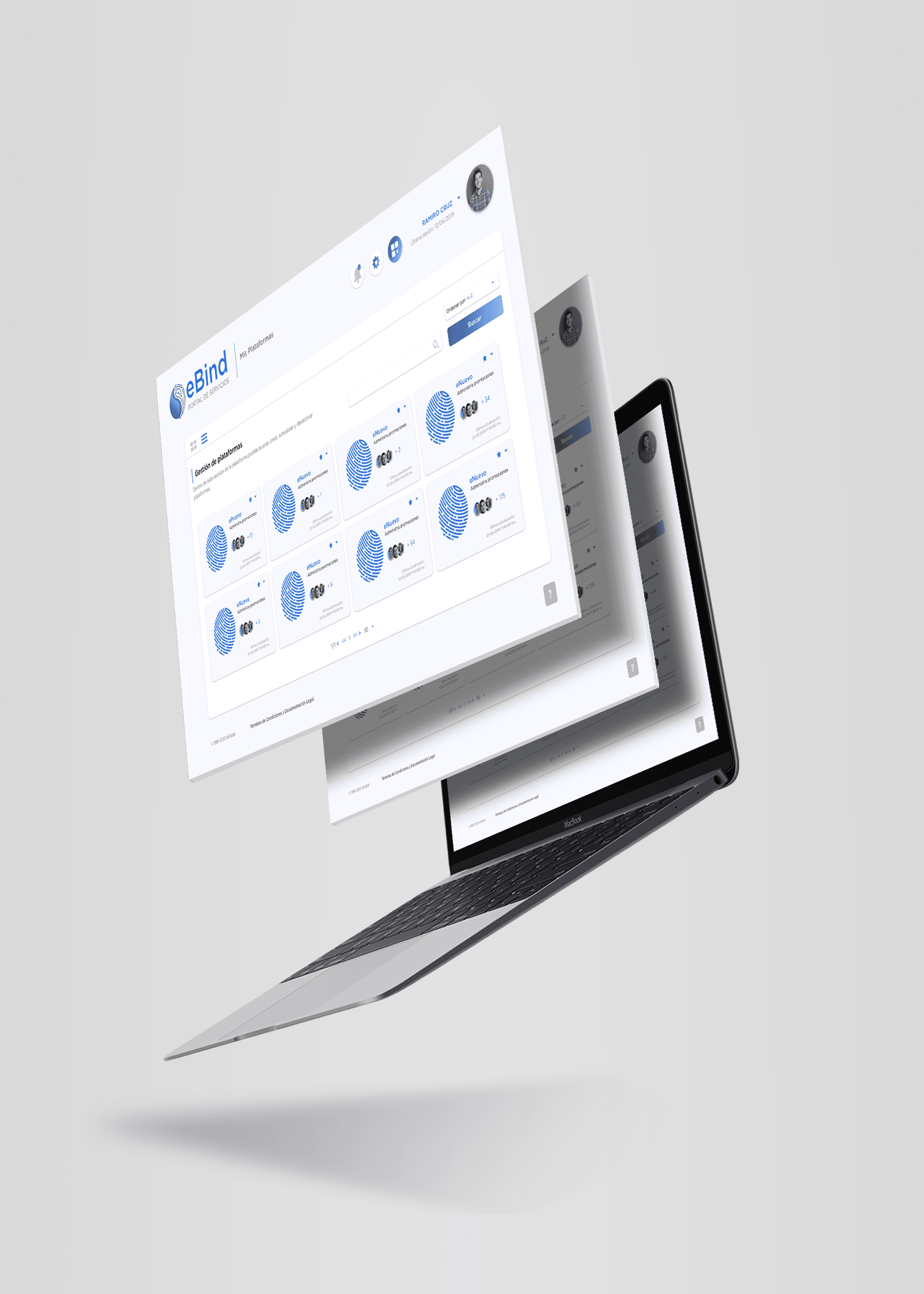
The work moved through three connected phases. SIAC+ began with UX research: a heuristic evaluation against Nielsen's and Weinschenck & Barker's usability principles, a competitive analysis, and user research into SIAC+'s two roles—before any wireframe was drawn.
That research fed a recommendation to eGlobal: rename and encapsulate the service rather than repair it, which became eBind. eBind's design phase built the information architecture, use-case models, and wireframes for a two-portal system—one for clients, one for administrators, converging on a single process—then translated that structure into a surface design proven across several bank brands, alongside a first internal module, ePromo, designed to exemplify how future modules should be structured.
As demand for more functionality grew, the work shifted into Portal Único: an audit of the existing app landscape, a full design system—components, responsive layouts, dark and light modes, multi-role access—and an information architecture built to hold a constellation of rebranded services rather than a single tool.
Varying from 16-24 weeks, scattered across 4 years


Key Design Principle
This meant designing one underlying system flexible enough to wear any client's brand, rather than a separate product for every client who asked for one.

Key Design Principle
This meant treating the design system itself as the product—the thing that actually lets dozens of independently built tools function and feel like one platform.
Conclusion
Looking at it from the start, this was a simple tool redesign. Looking at it from the end, it was the design system eGlobal's entire client-facing digital business now runs on.
What connects SIAC+, eBind, and Portal Único isn't three separate projects—but the same instinct applied three times at increasing scale: don't just fix what's broken, design the structure that lets the next version of the problem be solved by the same system. That's the kind of design work that compounds instead of restarting from zero each time.


